


.png)
The Amityville Horror Part Two: The Lutz Haunting
- Melissa Dawn

- Aug 10, 2023
- 8 min read
Originally published by Melissa Dawn April 2017. Revised in August 2023 for publication on this site.

Let me take you back to 1975, when there was no internet, no cable TV with 24-hour channels, no smartphones, and life moved much slower. Two years before the movie The Exorcist hit it big in movie theaters, it presented America and the world with a terrifying portrayal of evil that could possess a little girl. America was still predominantly Christian in religious belief, and people were more likely to attend church and believe in sin, as portrayed by The Church. Of course, 1975 is the year the Lutz family moved into the house on 112 Ocean Avenue in Amityville, located on the south shore of Long Island, New York.
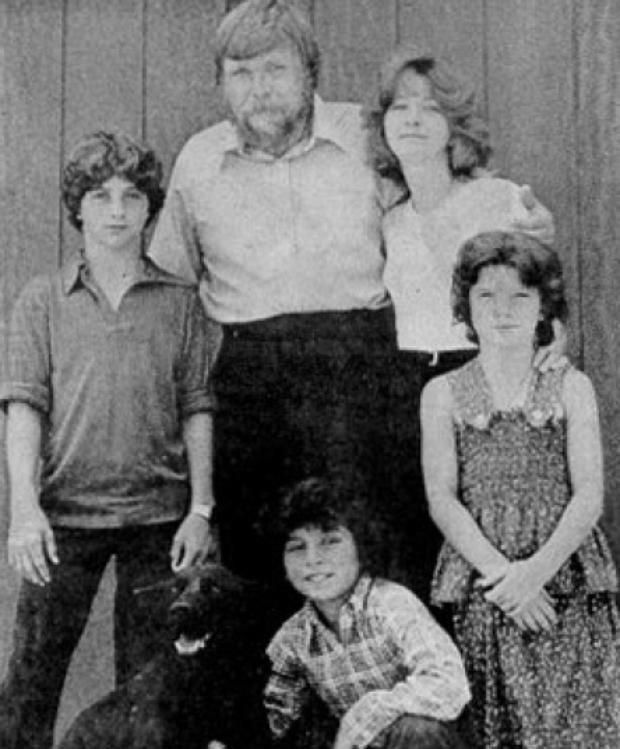
The house had been on the market at quite a reduced cost due to the Defeo murders the previous year. The house fits the Lutz's needs as the newlyweds, George and Kathy, combine their new stepfamily under one roof. They got many pieces of furniture from the Defeo estate included at a great price with the purchase of the house. Even though they were aware of the murders, the family discussed it together and couldn't see how the horrendous crime could affect their plans for a future in the house.
The five-bedroom Dutch Colonial house had everything they could want, including a boat house and outdoor pool, and at $80,000, they thought they could go right. However, after 28 days, the family fled the home, refusing to go onto the property, declaring that a succession of hauntingly evil events escalated into a final night of terror. In short, they would eventually have American author Jay Anson write a novel, "The Amityville Horror," on their experience. That novel would go on to be a box office smash hit movie.
Was the Lutz's story true? To come to any conclusion, we will have to re-examine some of the events between evacuating the house and the release of the book. There are huge discrepancies between the novel, movie, and what the Lutzes say happened. Events in the novel change with different editions because they are inaccurate. That's not my concern in this article. The book's writing and the film's making are actions the Lutzes had very little control over, and as George Lutz said, it was very "Hollywood" (Interview with Art Bell 2002).
According to George and Kathy, during the 28 days they stayed in the Amityville house, they experienced a milieu of paranormal events. Their actual declarations were as follows:
George wakes up at the same time in the morning that the murders happened (3:15)
Swarms of flies in the winter
Kathy has nightmares of the murders.
Kathy sensed being embraced by a loving presence.
George discovers a small hidden room.
Cold spots.
The smell of perfume.
George sees the image of a demon with his head blown half off while stoking the fire.
Melissa developed an imaginary friend, Jodi, while in the house.
George realized he resembled Defeo Jr. and began drinking at the local bar Defeo had frequented.
Kathy saw glowing eyes outside Melissa's bedroom window.
Kathy received welts on her chest while in bed.
Unseen force damaged locks, doors, and windows.
Cloven hoofprints they thought were an enormous pig they had seen outside in the snow.
Crucifix revolved until it was hung upside down in the living room and smelled sour.
Green-like gelatin oozed from walls in the hall and out of the keyhole in the attic door.
George tripped over the China Lion ornament in the living room only to find bite marks on his ankles, so he moved the lion, only to have it reappear.
George saw Kathy transform into a 90-year-old woman.
Melissa would sing in her room only, stop when she left, and then sing when entering again.
Kathy would hear windows opening and closing in the sewing room.
Kathy and George had then decided to do a blessing of their own, and upon citing the lord's prayer, they heard an echoing of voices commanding them, "Will you stop?". They attempted to bless the house again in mid-January, which would be their final night there. They also insisted that the energy had followed them to Kathy's mother's house in Deer Park upon fleeing. However, the movers went in when the Lutz's sent the moving company to remove their items the day after they left. They reported no paranormal phenomena and went about their jobs.
The chronology of what happened after this point can become confusing and change according to whom you talk to. There were several people involved in the investigation of the house that George Lutz didn't contact, but Channel 5's producer Marvin Scott. These people include Laura Didio, a journalist who got exclusive rights to cover the story, Lorraine & Ed Warren, self-proclaimed demonologists, and several other psychic investigators who were less known.

Investigations began with the Warrens, Didio, and many people holding a vigil at the house on Ocean Avenue. All involved declared the house intensely haunted, and in the words of Lorraine Warren, Amityville was "one of the most haunted houses" she'd ever been in. She has insisted until this day that the experience was highly negative and affected her life. During the team's time investigating the house, they proclaimed many events to have happened. Lorraine claims to have levitated; another psychic saw a young girl with long hair in one of the rooms, and they shot a photograph of the hallway that shows a boy poking his head out of a doorway when no children were in the house. (Added in August 2023, they claim that the boy in the photograph was the child of one of the people investigating the house.)

The picture of the little boy looking out of the door originally thought to be a ghost, but could possibly be the child of someone involved with the investigation.
Some of the psychic's explanations for the inconsistencies in the Lutz's stories with what reality showed (i.e., storms that never happened according to weather reports and doors ripped off hinges that didn't show evidence in existence) was that they were experiencing these events as psychic phenomena and apports. Apports are telepathic projections that go to the viewer; they bypass physical reality so that the viewer sees it the same way a medium would see it. However, unaware of the concept, the viewer mistakes it for reality.

One person George Lutz directly contacted was Defeo Juniors lawyer William Weber, and both men have a different story behind that collaboration. According to Lutz, he told Weber that he thought he could help Defeo and lend testimony to his insanity plea and get him help because Lutz believed that there was an evil force in the house. George declared he parted ways when Weber wanted to do a book deal and cut a 5% deal to DeFeo and wasn't interested in helping Defeo. Weber tells a different story: Jay Anson, Lutz, and himself sat around drinking wine and discussed how to concoct a hoax to make money.
What is evident is that Jay Anson would go on to write the novel that became The Amityville Horror, which would become a film that would launch the Lutz family into infamy that would continue for decades. There are so many angles to this, and we could believe Weber that it was all an illicit hoax. However, his position would cause him anger because he never got the book deal he wanted. Weber went on to try to conduct his investigation for a book and profit off the story by hiring Hans Holzer to go into the house and prove it wasn't haunted. Except, unfortunately for Weber, Holzer's experience was that it was indeed very haunted.

Another odd character surfaces as a critic of the Lutz's in that Stephen Kaplan questioned the changed details in different book editions. Kaplan wasn't just any individual being rationally skeptical; he, too, had attempted to get involved with The Amityville Horror from the beginning. Kaplan was a paranormal investigator and vampirologist who founded The Vampire Research Center. According to George Lutz, he had contacted Kaplan about investigating. Still, Lutz had decided to cancel because Kaplan's credentials didn't check out, and Kaplan's proclamation of himself as a vampirologist made Lutz uneasy (remember, it was the 70s still, and Kathy Lutz was Catholic). Kaplan said Lutz dismissed him because the Lutz's were frauds, and they knew he would find them out.

The joint declarations that the Lutz's created this hoax because they had taken on a mortgage that was too much for them to afford is also something that doesn't add up. Kathy and George had come into this with money, as both had sold houses they had before the marriage. George had a thriving business, and they had family support who would gladly help them. Remember, more than 28 days are needed to get into mortgage trouble with the bank; they wouldn't have even made one payment yet toward their dream house. That doesn't necessarily mean the Lutzes didn't wish to profit from this book; they did profit. After lawsuit settlements, they came away with over $300,000 US. However, that is paltry compared to the multiple millions Jay Anson, and American International Pictures would make off the story.
Are all the critics right about the Lutz's being a scam? Perhaps they are, or there is a core element of truth to the Lutz family's experiences. Perhaps the calamity ensued due to everyone else's dig to get in on the money. When you put content out to the public, it takes on its own life beyond the creator's control. At the time of the movie's release, the Lutzes took a polygraph test that could have been a publicity stunt. Still, a highly credible and experienced polygrapher did it, and they passed it on every account. (Update August 2023: Some say polygraphs aren't entirely reliable and not allowed as court evidence.)

To their dying days, both Kathy and George Lutz maintained their story to be accurate and never faltered from their narrative; even through a divorce, they did stick to their claims. The oldest son Christopher's story is now a documentary called My Amityville Horror, where even he declares that the house is haunted. However, his spin is that George Lutz was into the occult and had created the terrifying circumstances. Lutz never spoke of being into the occult, so I cannot confirm whether this is publicity hype or an element of truth from a different perspective.
I can conclude that everyone involved in this franchise stood to make money out of it, whether they adamantly supported the paranormal experience or were out to prove it a fraud. George Lutz made no secret that the book and movie were exaggerated. If the Lutz experience hadn't existed, none of these individuals would have made a name for themselves or made money writing their material. If they point the finger at the Lutz's wanting to make money, they also have a better look at their motives. If anything, it became quite a nightmare for the family in years to come, and they certainly didn't profit significantly in the grander picture.

The real Amityville Horror is the genuine horror of the murder of six innocent people. However, after 42 years, we cannot deny that the paranormal case of the Lutz's still holds a fascination for the public. Perhaps only George and Kathy will ever know that truth the public craves. I recommend you listen to Art Bell's interview with George Lutz; it's one of the best I've heard yet, and you get a fuller representation of George Lutz as a person.


Comments